Egyptian Blue — handmade from Egyptian raw materials
Our pigment production grows from a long-term research project in Cairo and Amsterdam, collaborating with Egyptologists, potters, and conservation specialists. We document each batch, its firing temperature, material behaviour, and infrared response.
Technical Data Sheet available on request.


Pigment
Handmade Egyptian Blue pigment fired in small batches, using raw materials sourced in Egypt. These include limestone, natron from both Egypt and Sudan and artisanal copper oxide made by coppersmiths and glassblowers in Cairo.
Each batch is documented for IR luminescence and ground by hand to a fine particle size.

Egyptian Blue – Cairo Batch No. 1
Properties:
- Small batch variation
- natron from Wadi Natroun
- Strong IR luminescence (800–1000 nm)
- Fine crystalline structure
- Compatible with gum arabic, casein, frankincense resin, tempera
Egyptian blue is the earliest known artificial pigment, developed in ancient Egypt more than four thousand years ago.

Egyptian Blue appears during the Old Kingdom (ca. 2600–2400 BCE) and remains in continuous use through the Ptolemaic and Roman periods. Its formula represents an early form of chemical engineering: a deliberate combination of silica, calcium, copper salts, and an alkali flux, fired at approximately 850–1050°C to form the copper-calcium silicate mineral cuprorivaite.
As a material, Egyptian blue was remarkably stable. It resisted fading, survived burial, and adhered well to plasters, woods, and stone. Ancient craftspeople used it in wall paintings, funerary objects, temple reliefs, faience workshops, and cosmetic preparations. Its production centers—likely situated near quarrying and artisan complexes—required knowledge of kiln construction, fuel management, and material sourcing.
Beyond historical reconstruction, this pigment’s strong infrared luminescence makes it a valuable material for conservation science, imaging, and research.
The pigment’s infrared luminescence, discovered only in the late 20th century, makes it an important tool for conservation science today. Under IR imaging, even microscopic traces of Egyptian blue fluoresce brightly, revealing lost patterns, underdrawings, and ancient restoration practices.
Our pigment production draws from this long history.
Using raw materials sourced in Egypt and small-batch firing methods, we recreate Egyptian blue with careful attention to historical composition and crystalline structure. Each batch is documented for particle morphology, firing conditions, and infrared response, continuing a lineage of material knowledge that spans millennia.
Our Story
Our project began in 2020, from a distant memory of a lecture by Dina’s former Egyptology professor, Salima Ikram, who recounted the story of a man in Fayoum attempting to recreate the lost recipe for Egyptian synthetic blue.

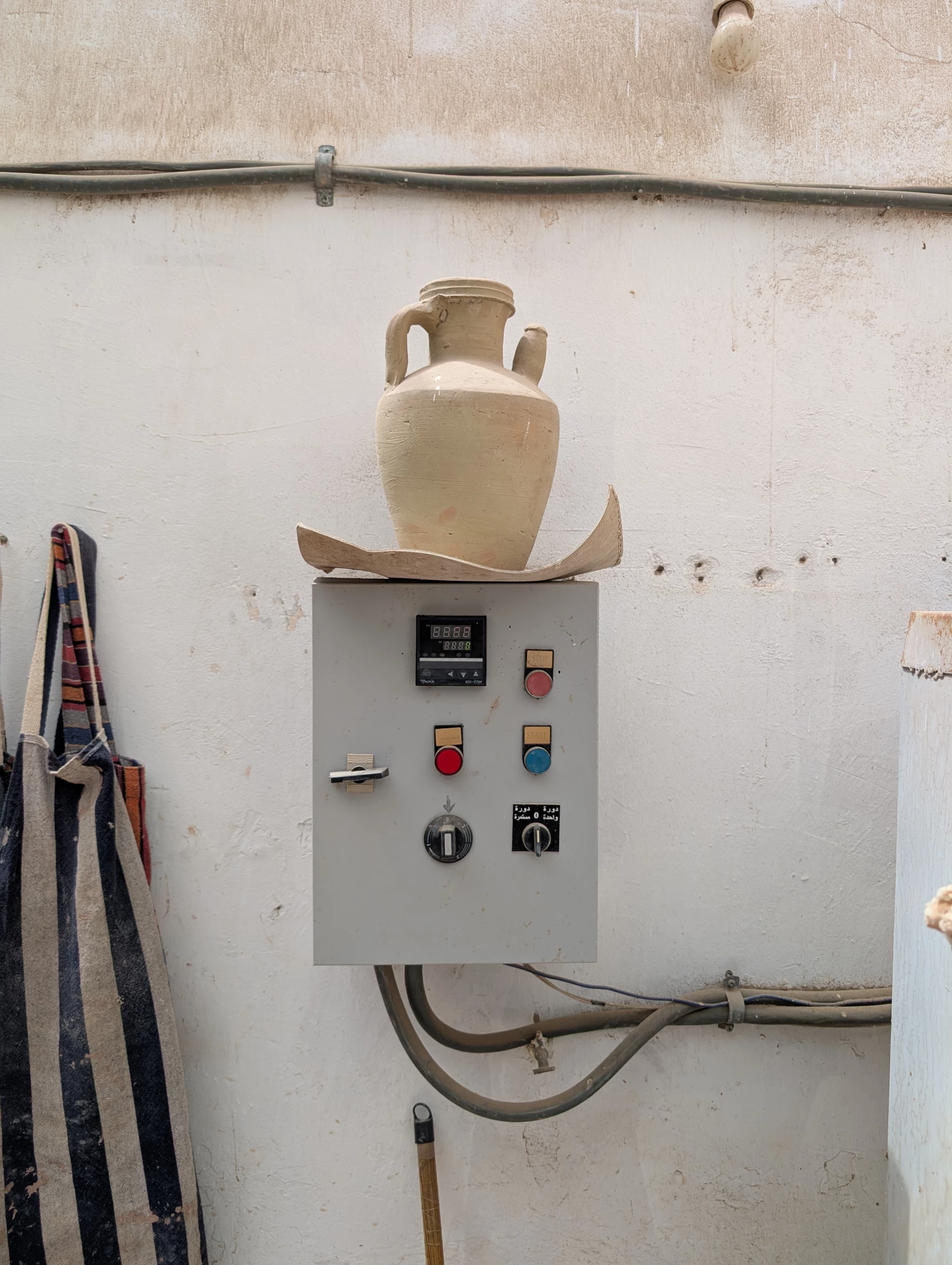


After learning he had passed away, we felt a strong urgency to preserve and carry forward the knowledge he had pursued. This became the starting point of our work. From 2023 to 2025 we spent time in Cairo reconstructing the pigment’s original local recipe.
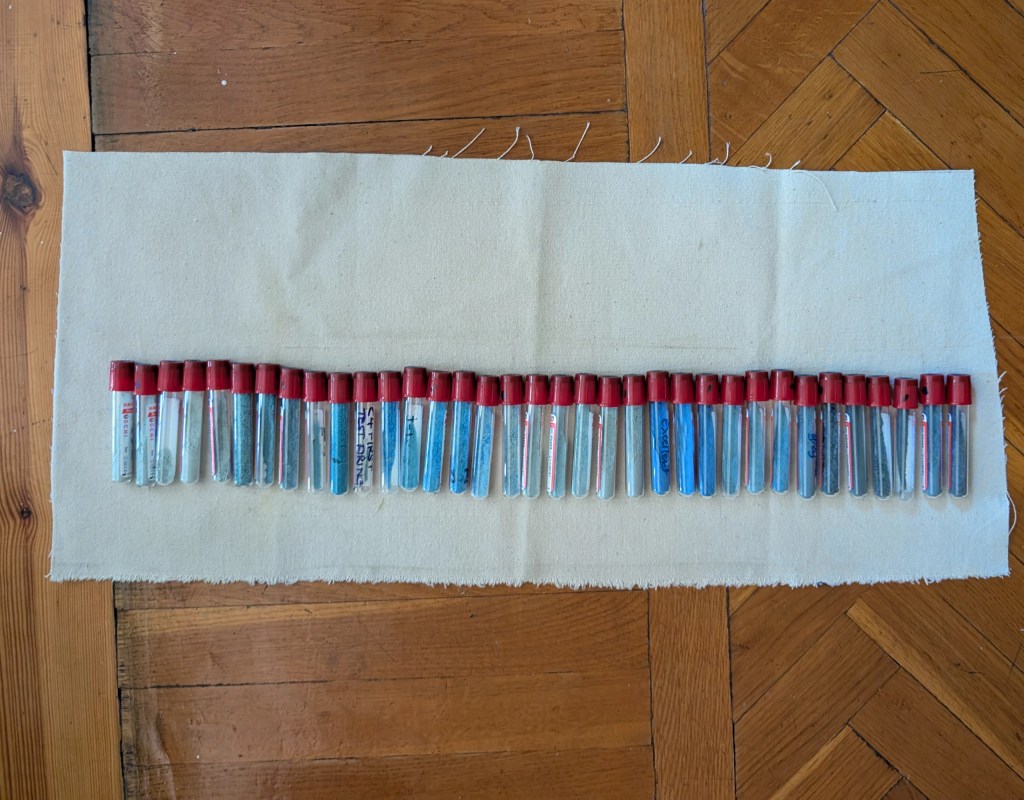
We were drawn to this pigment not only for its historical ties to protection from the Evil Eye in Egypt, but also for its remarkable material qualities—such as its ability to luminesce under infrared light. So far, we’ve developed around 50 test mixtures. After multiple firings, we produced a batch that the Cairo Museum of Egyptology confirmed as authentic Egyptian Blue.
Made by heating natural materials like sand and copper, this synthetic pigment resulted in a vivid blue used as a more accessible alternative to lapis lazuli, a stone long associated with holiness and the divine.


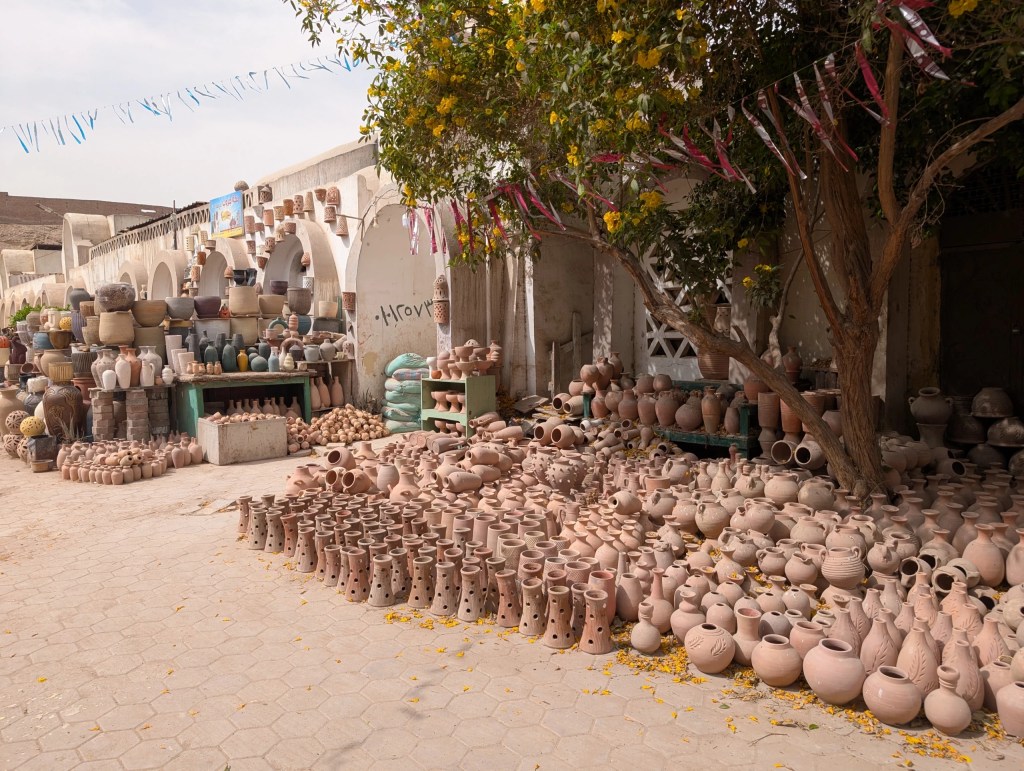



ABOUT US
Danish & Maitre is the collaborative practice of artists Dina Danish and Jean-Baptiste Maitre.
Our work bridges material research, experimental archaeology, and contemporary art.

Upcoming and Recent events
Seminar: DIVINE COLOUR – Reconstructing Egyptian Blue in Egypt
February 21, 2026
—
American University in Cairo
Date: February 21, 2026 – 11am-2pm
Location: Tahrir Campus, Hill House 102, American University in Cairo

In February 2026, we presented our research and experiments around Egyptian Blue to students of the Nederlands-Vlaams Instituut in Cairo (KU Leuven and Leiden University) and AUC.
Egyptian Blue is one of the first synthetic pigments developed in ancient Egypt more than 4,500 years ago. In this lecture, artists Dina Danish and Jean-Baptiste Maitre will introduce their four-year research into remaking this ancient Egyptian synthetic pigment in Egypt using locally sourced materials. They will discuss collaborating with local craftsmen in Cairo to recreate the forgotten recipe and their use of ancient texts, academic literature, and oral histories to develop their recipes, illustrating techniques of ethnoarchaeology and experimental archaeology.
While presenting images and footage of the project, they will explain their documentation process, firing methods, and tests using different binders on various surfaces. They will also discuss the pigment’s near-infrared luminescence and its cultural significance as a protective color associated with the Eye of Horus, the Evil Eye, and Nazar beads.
Special thanks to Dr. Salima Ikram, Dr. Ariel Singer, and Dr. Marleen De Meyer.
Artist Talk: Reconstructing Egyptian Blue in Egypt, Artists’ Perspective
March 1, 2026
—
CIC Cairo
Date: March 1, 2026
Location: Contemporary Image Collective, Cairo, Egypt

Artists Dina Danish and Jean-Baptiste Maitre will discuss their work in Egypt to remake the pigment using locally sourced materials. Collaborating with artisans in Cairo, they approach the project as an artistic investigation, experimenting with fire, sand, copper, and salt. In this talk, supported by the Mondrian Fund, they’ll share images and footage from the workshops, discuss their firing processes and material tests, and reflect on the pigment’s behavior as powder, surface, and image. They’ll also touch on its near-infrared luminescence and its historical association with protection, from the Eye of Horus to Nazar beads.
With special Thanks to the Mondriaan Fund, Dr Salima Ikram, Abdallah Sakr and the team of CIC
Keynote speakers: Vision and Depiction
February, 2026
—
TU Delft
Date: February 4-6, 2026
Location: TU Delft, The Netherlands

At the conference Vision and Depiction – II, we were honoured as keynote speakers and presented our research on the reconstruction of Egyptian Blue. This presentation provided an overview of the various stages of our research journey, from our initial recreations in Egypt to the unique challenges and distinct variations we encountered while continuing our work in the Netherlands. The video of our keynote presentation can be viewed on the website of the Technical University of Delft.
Further Experiments at Rijksakdemie
September, 2026
—
Rijkskademie Cermaics workshop
Date: September, 2025
Location: Rijksakademie, The Netherlands

In September 2025, our blue experiments in Amsterdam have been thriving, thanks to the help of the ceramic workshop and Marianne at the Rijksakademie. After refining the recipes, we’re now producing a larger batch of pigment—laying the groundwork for new visual works to be revealed in an upcoming exhibition.

